
Starlink Mobile Is Coming for Verizon, AT&T, and T-Mobile
SpaceX just announced that they plan to transform Starlink Mobile into a full service phone provider in the US. Their plan is ambitious, but should the big 3 carriers be worried?

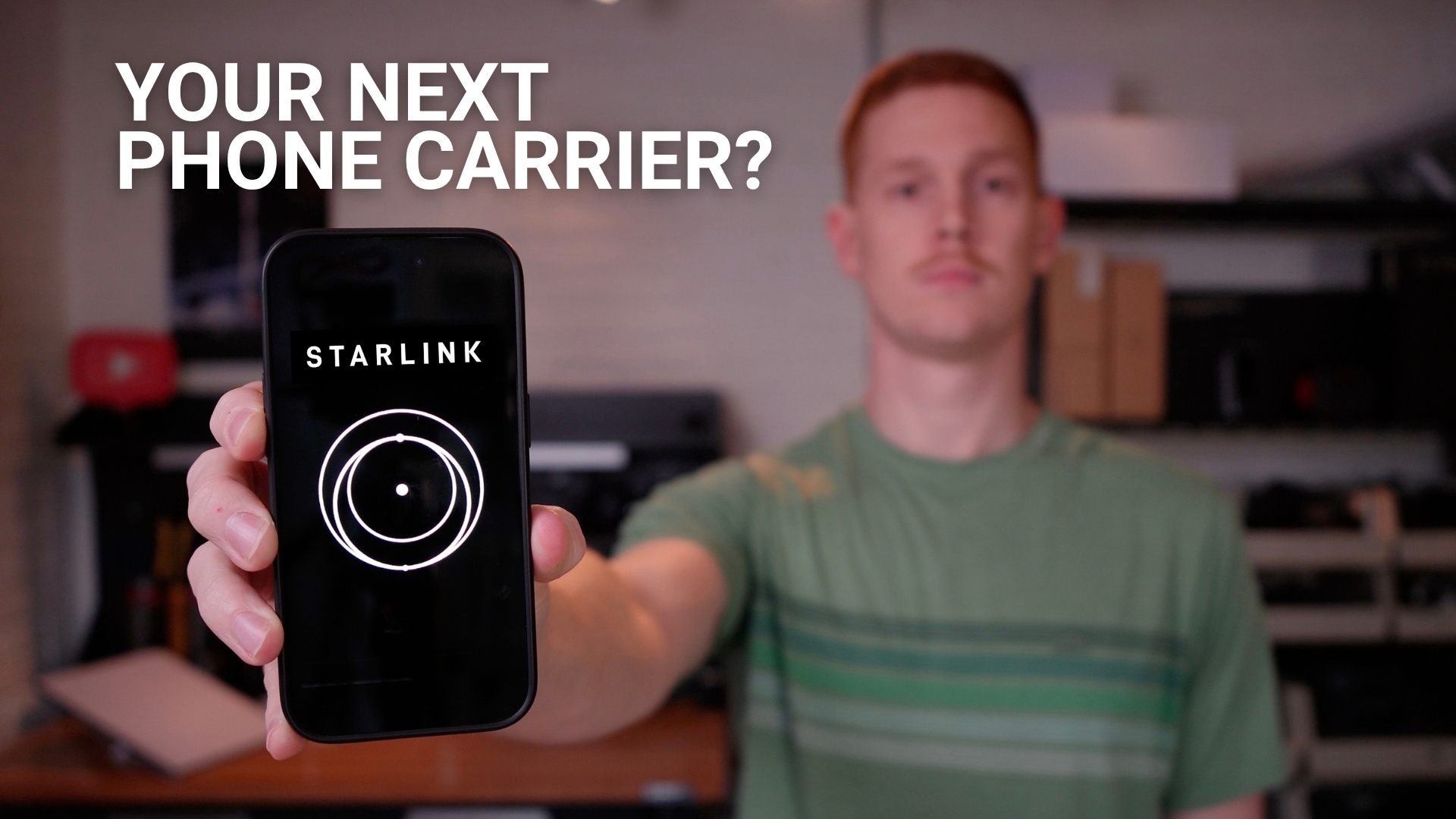
SpaceX has just made a huge announcement that is sending ripples through the industry. And I’m not referring to broadband satellite internet. I’m talking about the cell phone carrier industry. That’s right, SpaceX wants Starlink to be your next cell phone carrier.
SpaceX is aiming to enter the market as a complete cell phone service option in the United States. The announcement comes after the company agreed to acquire spectrum in the 800 MHz band for its upcoming Starlink Mobile network. SpaceX says this low-band spectrum addresses one of the remaining technical gaps in becoming a major US mobile carrier.
The plans are incredibly ambitious. SpaceX wants to combine its satellite network with ground infrastructure into a single service offering cell phone coverage under the Starlink Mobile name. This is a huge deal for SpaceX and Starlink, so let’s break down the announcement, how the network would work, and what it means for you moving forward.
Current Starlink Mobile Service
Let’s start with a little context, because Starlink Mobile is not new. SpaceX has been building its satellite-to-phone system for more than two years. But you might not recognize the Starlink Mobile name because it isn’t a standalone service you can buy directly from Starlink. In the United States, SpaceX partners with T-Mobile to offer the service through T-Satellite. You sign up through T-Mobile, rather than going directly to Starlink.
As it exists today, the system provides supplemental coverage from space. It connects your phone in remote areas where traditional cell phone signals aren’t available. It really is only coverage for dead zones. I’ve tried the service, and it works as designed, but the design itself is quite limiting.
Speeds can reach around 4 Mbps, which means the current system is mainly useful for basic text messaging and limited data through supported applications. Some supported apps also allow voice and video calling, but this isn’t the same experience you get from a regular cellular connection. And again, it’s designed to work when you don’t have traditional cell coverage available.
Although the technology is impressive, I think SpaceX expected more carriers to adopt it and pay to offer the service to their customers. So far, T-Mobile has been its US carrier partner. T-Mobile’s branding now centers on T-Satellite rather than Starlink, and the company has indicated that it’s open to other satellite connectivity partnerships. I wouldn’t assume this relationship will stay exclusive forever.
My take is that SpaceX sees a much bigger opportunity than supplemental coverage. Instead of relying entirely on existing carriers to bring Starlink Mobile to customers, it wants to become a carrier itself. That means competing directly with the companies it originally hoped to partner with.
Hybrid Network Solution
SpaceX wants to move Starlink Mobile from supplemental coverage to a full network service. Its plan is to use a hybrid approach. At the core are the next-generation Starlink Mobile V2 satellites, which are designed to offer significantly more capacity than the first-generation system.
The FCC has approved SpaceX’s Gen2 mobile constellation application, authorizing 15,000 satellites optimized for 2 GHz spectrum. That is a huge expansion from the roughly 650 satellites in the current mobile constellation. It gives you an idea of how serious SpaceX is about building a much larger network for cell phone users.
But the satellites are only one part of it. If Starlink wants to offer service in rural, suburban, and urban areas, it has two big problems to solve. The first is user density. Satellite systems have a harder time providing enough capacity when large numbers of people are packed into the same area. Adding satellites helps, but there are still limits to how much traffic the system can handle in a particular location.
That’s where ground infrastructure comes in. SpaceX plans to supplement the satellites with small terrestrial cell sites in areas that need more capacity or better coverage. Think of smaller units installed on buildings or in other strategic locations, serving a more limited area than a traditional cell tower. The idea is to let the satellites provide broad coverage while the ground network fills in the places where satellites alone aren’t enough.
The second problem is getting a reliable signal indoors. With the current Starlink Mobile system, your phone generally needs a clear view of the sky. Once you go inside a building, get into a vehicle, or move under heavy tree cover, the connection can become less reliable. And that brings us to the spectrum purchases.
Radio Spectrum Purchases
The 800 MHz spectrum agreement is a big part of SpaceX’s plan. Lower-frequency signals generally travel farther and penetrate obstacles better than higher-frequency signals. That makes this spectrum useful for improving coverage inside buildings and in other places where the current satellite connection struggles. But better signal penetration doesn’t automatically mean a satellite will provide a reliable connection through every wall or in every building. The ground network will still matter.
SpaceX has also agreed to acquire spectrum around 2 GHz from EchoStar, the company behind Boost Mobile. Together, these frequencies give SpaceX more flexibility. The low-band spectrum can help with coverage and signal penetration, while the higher-frequency spectrum can support more capacity.
SpaceX has discussed speeds of up to 150 Mbps for its next-generation mobile system. That would be a huge upgrade over the roughly 4 Mbps available through the first-generation constellation. Those are 5G-class speeds, and if SpaceX can deliver that kind of performance consistently, Starlink Mobile becomes a much more useful service.
Will You Need A New Phone?
With all this new spectrum, you might be wondering: will my smartphone support it, or will I have to upgrade? This is where things get a little complicated.
The current Starlink Mobile system uses T-Mobile spectrum that compatible phones already support. That allows it to connect to existing smartphones without a separate satellite antenna or accessory. You still need a supported device and service plan, but with the V2 constellation, compatibility could change.
Support for some of the new frequencies and satellite capabilities may require updated phone hardware. SpaceX has said it is working with manufacturers so future phones can support the next-generation network. But we don’t have enough detail yet to say exactly which phones will work or which features will require an upgrade.
I wouldn’t assume that every older phone will be completely incompatible. At the same time, I wouldn’t assume your current phone will support everything Starlink Mobile V2 offers. We’ll have to wait for a supported-device list and more details about how the service will work.
Challenges To Create A Mobile Network
So far, we know SpaceX wants to turn Starlink Mobile into a full-service network. It has announced important spectrum agreements, received approval for a much larger satellite constellation, and outlined a hybrid approach using satellites and ground infrastructure. But it still has a ton of challenges to solve.
The first is launching the satellites. SpaceX has said it plans to start deploying Starlink Mobile V2 satellites in 2027, using Starship. Just like the next-generation Starlink broadband satellites, that makes the schedule dependent on Starship being ready. If Starship is delayed, the mobile network could be delayed along with it.
The second challenge is building the ground infrastructure. Even with the new spectrum, I don’t think SpaceX can offer a complete nationwide service using satellites alone. In urban and suburban areas, user density will put pressure on capacity. Indoor coverage will also vary.
The small cell sites are supposed to help solve those problems, but installing them takes time and money. SpaceX will need locations, power, connections to the rest of the network, and permission to deploy them. We still don’t know how quickly it can build that infrastructure or how extensive it will need to be.
Another challenge is the timing of the spectrum deals and regulatory approvals. Announcing an agreement doesn’t mean SpaceX can immediately start using all the spectrum. The EchoStar transaction is expected to close in late 2027. That is another piece of the schedule, separate from launching satellites and building the ground network.
And finally, there are the phone hardware changes. If full compatibility requires new devices, manufacturers will need time to incorporate that support into their products. Customers will then need access to those phones. All these pieces have to come together, which is why I keep calling the plan ambitious.
When Will Starlink Mobile V2 Be Available?
If I had to guess, I would say the first half of 2028 is an optimistic timeline for an initial customer rollout. That is my estimate, not an announced launch date. More realistically, I could see deployment extending through 2028 and into 2029 as SpaceX launches satellites, builds the ground infrastructure, and works through device compatibility.
There’s also a difference between launching service in some areas and offering a complete alternative to the major carriers across the country. This is a long-term plan. It’s not something I would expect to come together in the next six months.
SpaceX vs Verizon, T-Mobile, and AT&T
The last question is whether Starlink can actually compete with Verizon, T-Mobile, and AT&T as a full network carrier. The existing carriers have been skeptical of the idea, and I think Elon Musk takes that kind of skepticism as a challenge. Across his businesses, he has pursued ideas that people thought were unrealistic. They don’t all work, but some certainly do.
I have an entire channel dedicated to Starlink satellite internet, a technology plenty of people would have doubted ten years ago. Starlink is now helping SpaceX invest in projects like the next-generation mobile network, so I wouldn’t dismiss the idea just yet.
At the same time, we need to keep expectations in check. Verizon, T-Mobile, and AT&T have spent years building extensive cellular networks. In established areas, they already have infrastructure that Starlink will need time to compete with.
Starlink Mobile will have to lean into its advantages. One of the biggest could be coverage. A satellite network can reach remote places where building traditional cell towers isn’t practical. Combined with ground infrastructure, that could make Starlink an appealing option for people who travel or regularly lose service.
SpaceX also has an opportunity to offer both home internet and cell phone service under the same brand. Imagine having one bill covering your Starlink home internet and your Starlink Mobile service. That would be pretty amazing. We don’t know whether SpaceX will offer a bundle like that, but the potential is there.
And I think people underestimate the desire for alternatives. I’ve already covered people switching from cable or fiber to Starlink, even when their existing service might be the better option on paper. Sometimes people simply want to try something different. Sometimes they’re fed up with their provider. There are almost certainly customers at Verizon, T-Mobile, and AT&T who would love another option.
That doesn’t mean they’ll accept unreliable coverage or poor performance. Starlink will still have to deliver a service people can depend on. Pricing could be the final determining factor. How much will it cost? What will the plans include? Will it be competitive with the carriers people already use? Until we know those answers, it’s hard to predict how successful Starlink Mobile will be.
But SpaceX doesn’t have to put the big three out of business to make a difference. Becoming a credible fourth option would give customers more choice and give the existing carriers another competitor to worry about.
